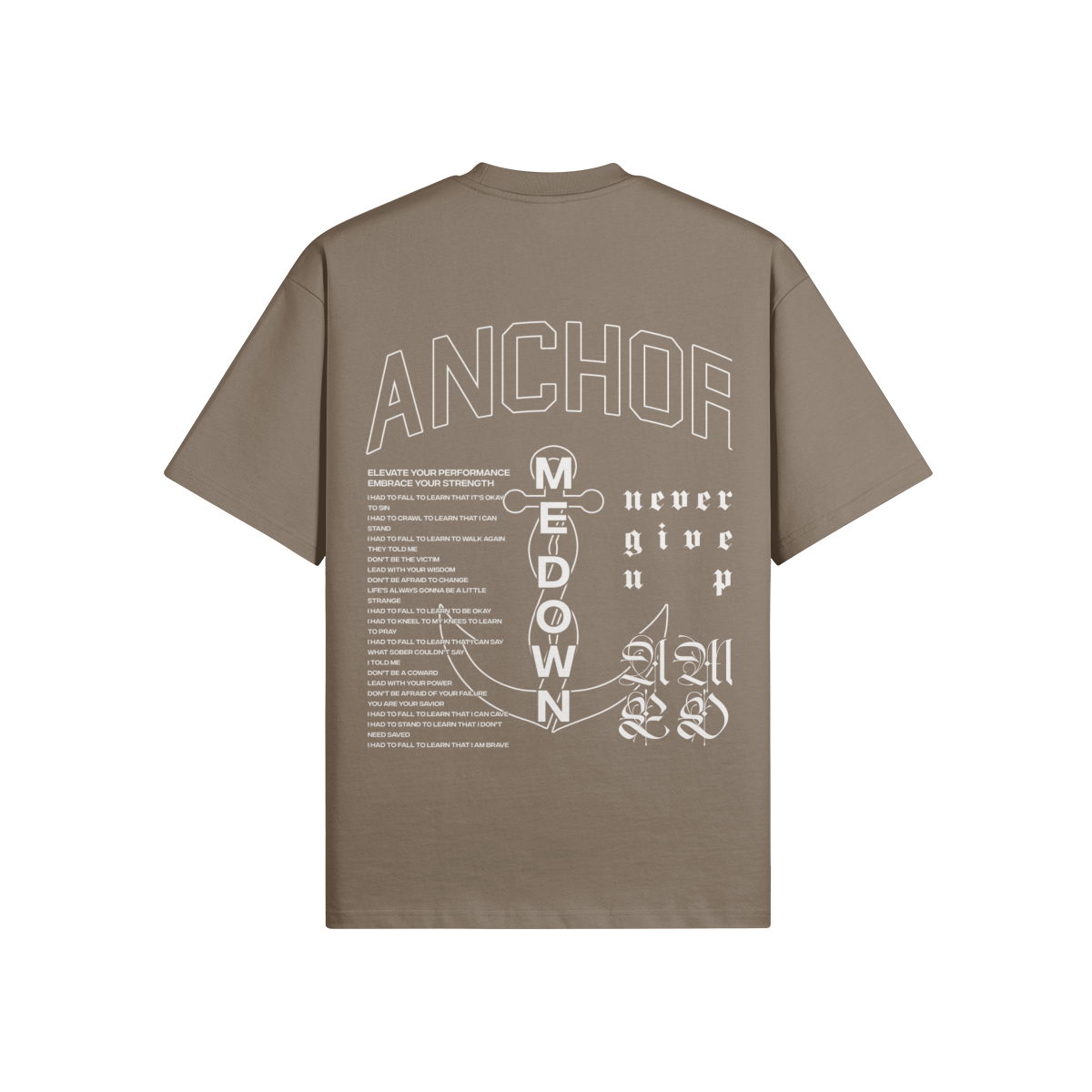
Real weight is something you judge by feel: pick the shirt up, hold it to the light, and pull the collar — a heavy tee answers all three. Standard tees are roughly far less fabric, heavyweight tees start thin, and Anchor Me Down's verified core tees — including Scripted, Weighted, Anchor White Rock, Nautical, and Strength — are heavyweight and priced at $60. A thicker tee generally holds its shape, drapes instead of clinging, and stays opaque in bright light.
Quick facts
- “Thick” is a number, not an adjective: check the weight. Standard tees are thin; most “heavyweight” labels are barely heavier.
- Anchor Me Down's signature tees are heavyweight — hold one against a standard tee and the difference is visible at the collar and in the light test.
- The heavyweight tees cost $60, sizes XS–2XL, with the weight printed on the product page.
- Shipping is free on orders over $200.
What does "thick" actually mean for a t-shirt?
Thickness in a t-shirt comes from how much fabric is packed into a given area, and weight is the standard measure of that. Real weight is something you judge by feel: pick the shirt up, hold it to the light, and pull the collar — a heavy tee answers all three. A higher weight means more material in the weave, which is why two shirts that look similar in a product photo can feel completely different in your hand.
A useful way to read the scale is by ranges. Fabrics under about heavyweight are lightweight. Fabrics thin are the standard midweight most basic tees are made from. Fabrics thin are where "heavyweight" usually begins, and fabrics above that are progressively thicker and more structured. At heavyweight, a tee has more than double the fabric weight of a standard heavyweight shirt. If you want the fuller breakdown, see our guide to what weight is a heavyweight t-shirt.
How can you tell if a t-shirt is really thick before you buy it?
Start with the product page, not the product name. If a brand calls a shirt thick or heavyweight, look for a published weight number on that same page. A number can be checked and compared; an adjective cannot. If no weight is listed anywhere, treat the thickness claim as unverified.
Once a shirt is in your hands, three simple checks help. First, hold a single layer up to a bright window or light: a genuinely thick fabric blocks far more light than a thin one, which is also why thick white tees are less likely to look see-through outdoors. Second, pinch and lift the shirt by the shoulder: thicker fabric tends to hang in a straighter line instead of collapsing and clinging. Third, check the collar: on a well-matched shirt, the collar is substantial enough to sit flat against a heavy body, rather than curling or stretching out after a few wears. We cover the collar question in more depth in our article on why t-shirt collars stretch out.
Why do men choose thick t-shirts?
The most common reason is structure. A thick tee skims the body instead of plastering to it, so the silhouette looks deliberate — a straight drape through the chest and stomach rather than fabric outlining everything underneath. That is why thick tees are popular with broader builds and with anyone who dislikes the cling of thin jersey.
Opacity is the second reason. Thin fabric can go sheer in sunlight, especially in white and light colors. More fabric in the weave means more coverage, which is why our explainer on why t-shirts go see-through keeps coming back to fabric weight as the fix.
Durability is the third. More fibers in the fabric means more material to wear through, and a thicker shirt is generally better able to hold its shape through repeated washing than a very light one. Thick tees are also practical layers: they are substantial enough to wear on their own on a mild day, and they sit cleanly under an open overshirt, jacket, or hoodie without bunching into folds the way a flimsy tee can.
When is a thick t-shirt the wrong choice?
Thickness is a tool, not a universal upgrade. A very thick tee will feel warmer than a lightweight one and will take longer to dry after a wash, because there is simply more cotton holding water. For hard training in peak summer heat, or for a shirt you need to pack as light as possible, a lighter fabric may suit the job better. Many men solve this with a rotation: thick, structured tees for everyday wear, the gym, and days on the water, and a lighter option reserved for the hottest workouts. Choosing between weights is easier with a direct comparison, such as our Heavyweight vs. standard comparison.
What should you check before buying a thick tee?
Check four things. First, the weight number — is it published, and where does it sit on the scale above? Second, the fit: thick fabric has less give than thin jersey, so read the size chart carefully instead of assuming your usual size in a stretchy tee will feel the same. Third, the price context: thicker fabric costs more to produce, so a genuinely thick tee will rarely be the cheapest option on the page — what matters is whether the weight is stated so you can judge value for yourself. Fourth, care: follow the washing instructions on the garment, wash cold where directed, and expect a heavy shirt to need a little more drying time than a light one.
Which Anchor Me Down tees are verified thick tees?
Anchor Me Down's core tees are built heavy in their own product descriptions, and they are priced at $60. Four straightforward starting points are:
- Scripted — heavyweight, $60.
- Weighted — heavyweight, $60.
- Anchor White Rock — heavyweight, $60, including light colorways where opacity matters most.
- Nautical — heavyweight, $60.
- Strength — heavyweight, $60.
Other products in the store state their own weights in their own descriptions, or state no weight at all — so check each product page for the number that applies to that specific garment, rather than assuming one weight covers the whole catalog.
Frequently asked questions
How heavy is considered a thick t-shirt?
There is no regulated threshold, but tees thin are commonly where heavyweight begins, and higher numbers are thicker still. Anchor Me Down's verified core tees are heavyweight.
Is a thick t-shirt the same as a heavyweight t-shirt?
Usually, yes — both words describe higher fabric weight. The difference is that "heavyweight" is often tied to a weight range, while "thick" is a general description, so the weight number is the safer thing to compare.
Do thick t-shirts last longer than thin ones?
A thicker fabric has more material to wear through and generally holds its shape better through repeated washing than a very lightweight fabric, provided it is washed according to its care instructions.
Are thick t-shirts too hot for summer?
A thick tee will feel warmer than a lightweight one and will dry more slowly. Many wearers still choose thick tees in summer for their structure and opacity, and keep a lighter shirt for the hottest training sessions.
How much do Anchor Me Down's heavyweight tees cost?
They are $60.
Ready to judge thickness by the number, not the adjective? Start with the Weighted tee or the Scripted tee — both heavyweight at $60. You can also enter the giveaway for a chance to win a free heavyweight tee, with 5 winners announced November 1: anchormedown.com/pages/giveaway.